
‘발품’ 팔던 식자재 유통, 온라인으로…산업의 판이 바뀐다
식자재유통 | 2026.08.20
‘발품’ 팔던 식자재 유통, 온라인으로…산업의 판이 바뀐다
전화·대면 거래 중심이던 식자재 유통, 플랫폼·데이터·물류 결합하며 새로운 국면
가격 비교·거래 효율화에 이어 지역 판매자 판로 확대까지…‘유통 선순환’ 기대
CJ프레시웨이, 식자재 오픈마켓 ‘식봄’ 통한 B2B 식자재 유통 온라인 전환 선도
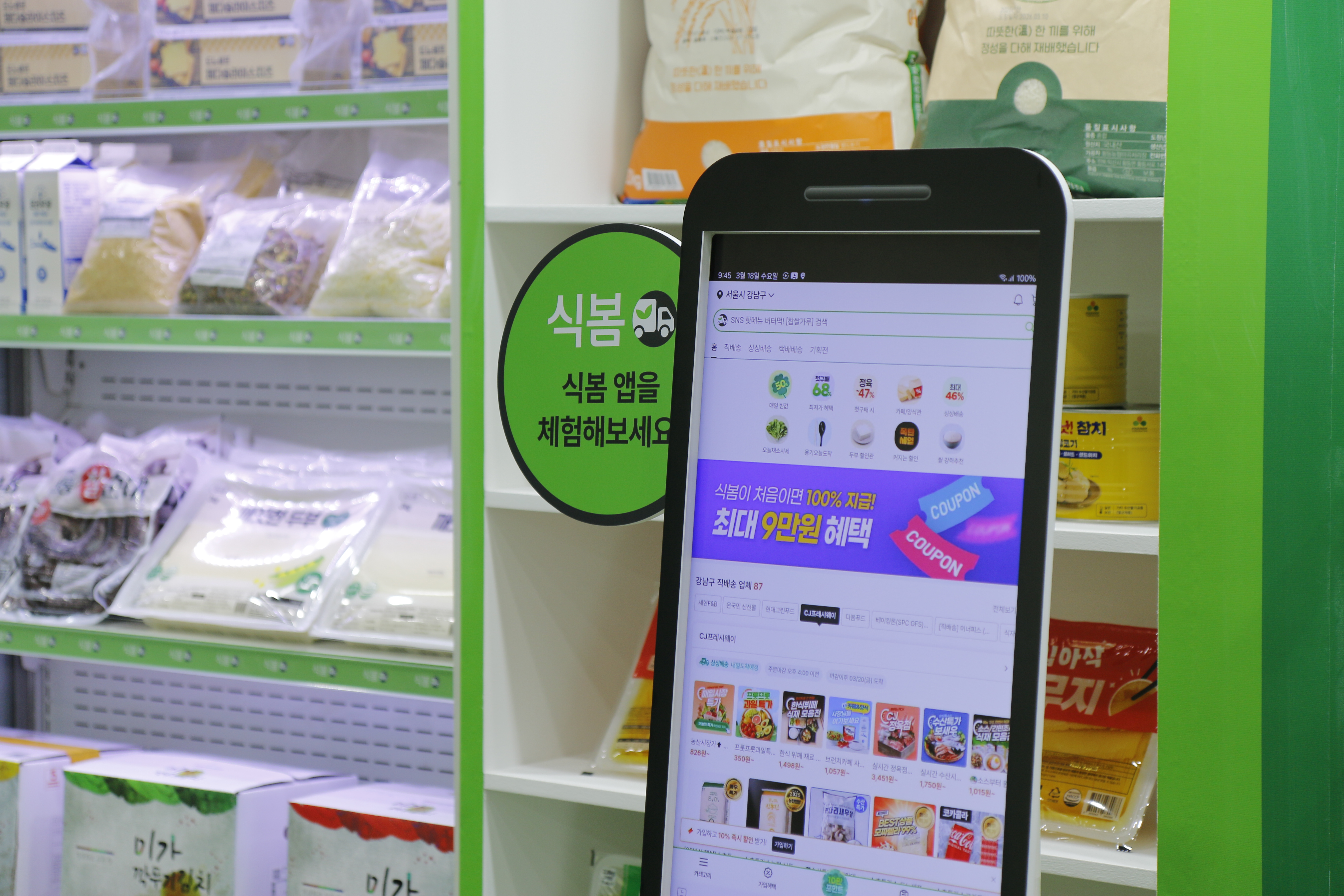
외식업자가 식자재를 구매하는 풍경이 달라지고 있다. 과거에는 이른 새벽 시장에 나가 직접 상품을 확인하거나 거래처에 전화를 걸어 필요한 식자재를 주문하는 일이 일반적이었다. 농산물, 축산물, 수산물, 가공식품 등 품목별로 거래처가 달라 주문과 배송을 각각 관리해야 하는 경우도 많았다. 식자재 유통산업이 오랜 기간 오프라인 중심으로 유지돼 온 이유다.
하지만 최근 들어 식자재 유통에도 온라인 전환이 본격화하고 있다. 온라인 플랫폼에서 다양한 상품과 가격을 비교하고 주문하는 것은 물론, 여러 판매자의 상품을 한 번에 배송받는 서비스까지 등장했다.
단순히 주문 방식이 바뀌는 데 그치지 않는다. 생산자와 판매자, 구매자를 하나의 플랫폼으로 연결하면서 기존 유통 과정의 비효율을 줄이고 새로운 판로를 만들어내는 방향으로 산업의 구조 자체가 바뀌고 있다.
■ 발품에서 시스템으로…식자재 유통의 변화
식자재 유통은 외식·급식산업의 성장과 함께 전문화돼 왔다. 초기에는 지역 도매시장과 중소 유통업체를 중심으로 거래가 이뤄졌지만, 프랜차이즈와 기업형 외식, 단체급식 시장이 성장하면서 보다 안정적인 공급망이 필요해졌다.
이에 따라 대량 구매와 상품 소싱, 물류센터, 냉장·냉동을 아우르는 콜드체인, 식품안전 관리 등이 식자재 유통기업의 핵심 역량으로 자리 잡았다. 식당 입장에서는 여러 시장과 거래처를 직접 찾아다니는 대신 전문 유통기업을 통해 다양한 식자재를 공급받을 수 있게 됐다.
이후 인터넷과 모바일이 확산되면서 전화나 대면 중심의 발주 방식도 온라인으로 이동하기 시작했다. 다만 초기 온라인 전환은 기존 거래처에 온라인 주문 기능을 더하는 수준에 가까웠다. 본격적인 변화는 여러 판매자의 상품을 한곳에서 비교하고 구매할 수 있는 ‘오픈마켓’이 등장하면서 시작됐다. 식자재가 온라인에서 하나의 시장을 형성하기 시작한 것이다.
■ 본격 성장기 돌입한 B2B 온라인 식자재 시장
온라인 식자재 유통의 성장은 거래 규모에서도 확인된다. 국내 대표적인 B2B 식자재 오픈마켓인 ‘식봄’의 연간 거래액(GMV)은 2022년 약 200억 원에서 2023년 560억 원, 2024년 1,537억 원, 2025년 2,342억 원까지 성장했다. 2025년 거래액은 2022년과 비교하면 약 10배 수준으로 확대됐다.
2026년에도 성장세는 이어지고 있다. CJ프레시웨이의 2026년 2분기 IR 자료에 따르면 식봄의 2026년 상반기 누적 GMV는 1,513억원으로 전년 동기 대비 25.8%의 높은 성장성을 보였다.
업계에서도 온라인 식자재 구매 시장이 본격적인 성장 단계에 들어섰다는 평가가 나온다. IBK투자증권은 2026년 8월 7일 발표한 CJ프레시웨이 기업분석 리포트에서 2026년 1분기 식봄 GMV 성장과 가입자 및 반복 구매 확대를 근거로 온라인 식자재 구매 시장이 자리 잡고 있다고 분석했으며, 현재 성장세가 이어질 경우 2026년 GMV가 약 2,800억 원에 이를 것으로 전망했다. 식자재 유통의 온라인 전환이 더 이상 실험적인 단계가 아니라 실질적인 시장 성장으로 이어지고 있다는 의미다.
■ 가격 비교 쉬워지고 거래 과정은 간소화
식자재 유통의 온라인 전환이 주목받는 이유는 구매자의 편의성만이 아니다. 가장 직접적인 변화는 상품과 가격 정보를 비교하기 쉬워진다는 점이다. 기존에는 외식업자가 여러 거래처에 일일이 가격을 문의하고 조건을 확인해야 했다.
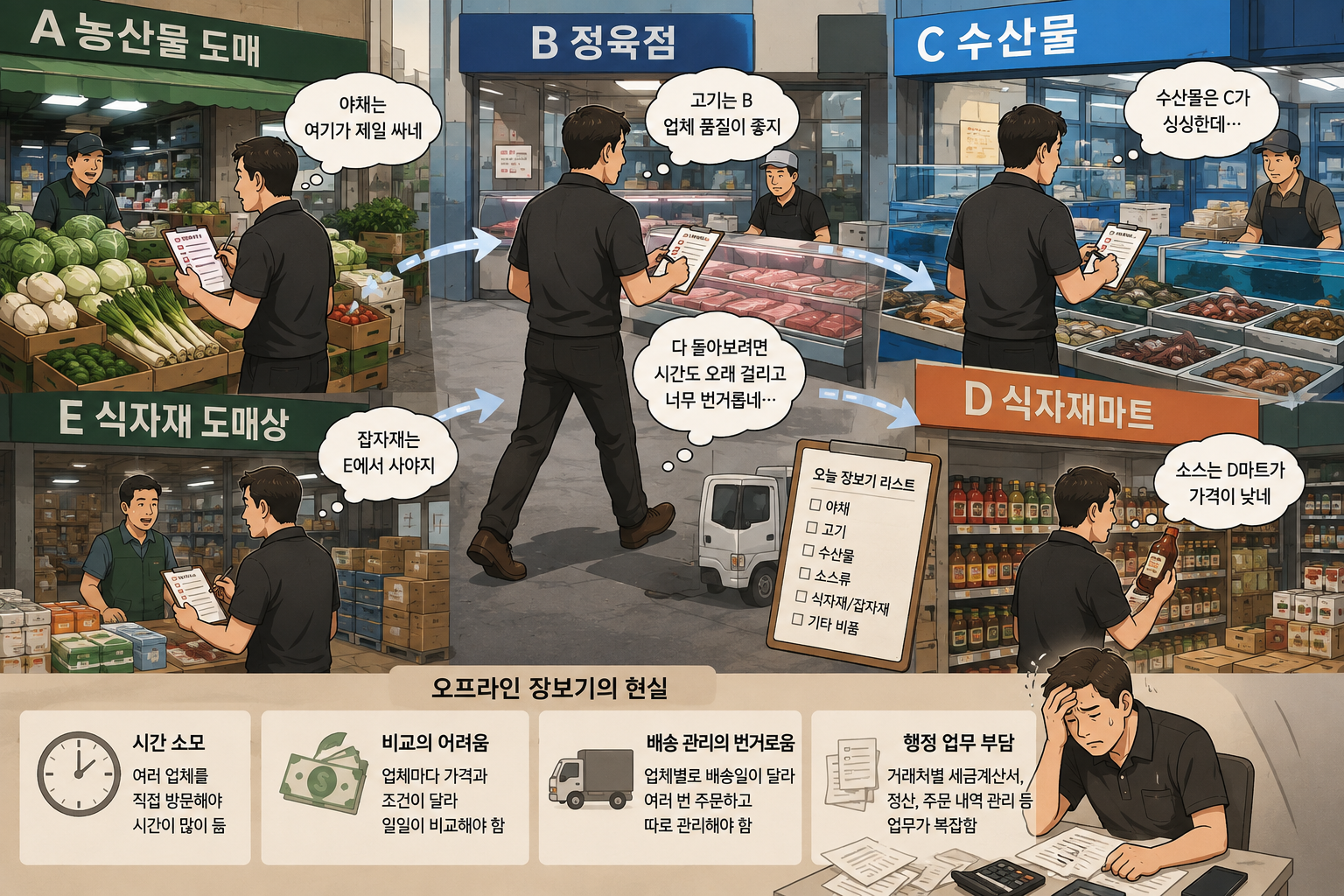
반면, 오픈마켓에서는 여러 판매자의 상품과 가격, 배송 조건 등을 한 곳에서 확인할 수 있다. 구매자의 선택권이 넓어지고 판매자 간 경쟁이 촉진되면 거래의 투명성과 효율성을 높이는 효과도 기대할 수 있다.
유통 과정에서 불필요한 거래 단계를 줄이고 생산자·판매자와 구매자를 보다 직접적으로 연결할 수 있다는 점도 온라인 유통의 특징이다. 식자재는 외식·급식업체의 원가와 직결되는 만큼 이러한 유통 효율화는 장기적으로 외식업체의 구매 부담을 낮추고 식품 물가 안정에도 긍정적인 영향을 줄 수 있다.
다만, 온라인 전환이 곧바로 모든 식자재 가격을 낮춘다는 의미는 아니다. 상품의 산지 가격과 생산비, 물류비 등 여러 요인이 식자재 가격에 영향을 미치는 만큼 온라인 플랫폼의 역할은 가격 형성 자체보다 가격과 상품 정보를 투명하게 비교할 수 있는 환경을 만들고 거래 과정의 비효율을 줄이는 것에 가깝다는 평가다.
2026년 3월 31일 동아일보는 “국내에서만 63조 원에 달하는 B2B 식자재 유통 시장은 여전히 오프라인 중심인데 이 같은 구조가 유통 효율성과 가격 투명성을 떨어뜨리고 있다. 주요 기업들이 온라인몰을 앞세워 가격 경쟁을 촉진하면서 가격 투명성이 높아지고, 유통 단계 축소로 인한 비용 절감 효과도 발생하고 있다. 농림축산식품부에 따르면 농산물 기준 온라인 유통 전환 시 유통비용률은 약 11%포인트 감소하는 것으로 나타났다”고 보도한 바 있다.
■ 지역 기반 판매자도 전국 고객 만날 수 있어
온라인 식자재 유통의 또 다른 순기능은 판로의 확대다. 지역에서 좋은 상품을 생산하거나 유통하더라도 전국에 판매하려면 영업망과 물류 인프라가 필요하다. 특히 중소 식품 제조·유통사나 지역 기반 판매자가 자체적으로 전국 단위 배송망을 구축하는 데는 한계가 있다.
온라인 플랫폼과 물류 인프라가 결합하면 이러한 제약을 낮출 수 있다. 판매자는 플랫폼을 통해 지역의 한계를 넘어 전국의 외식사업자를 고객으로 확보할 수 있고, 구매자는 기존에 접하기 어려웠던 지역의 다양한 식자재를 온라인에서 만날 수 있다.
특히 여러 판매자의 상품을 하나의 물류망으로 묶어 배송하는 통합배송이 가능해지면 효과는 더욱 커진다. 식봄은 CJ프레시웨이의 전국 23개 물류 거점과 콜드체인을 활용해 여러 판매자의 상품을 한데 모아 다음날 일괄 배송하는 방식으로 통합배송을 운영하고 있으며, CJ프레시웨이의 2026년 2분기 IR자료에 따르면 2026년 6월말 기준 식봄의 통합배송 이용 건수는 약 1.3만건으로, 전년 동기 대비 117.2% 증가했다. 결과적으로 배송망이 없는 판매자도 CJ프레시웨이의 물류 인프라를 활용하면 전국의 외식사업자에게 상품을 공급할 수 있다. 온라인 플랫폼이 단순한 ‘판매 공간’을 넘어 판매자의 물류 부담을 낮추고 판로를 넓혀주는 인프라 역할까지 수행하는 셈이다.
실제, 지역을 기반으로 하는 판매사의 식봄 입점 효과는 결과로 나타나고 있다. 경기도 이천시에서 채소 농장을 운영하는 ‘쉐프의정원’은 식봄 입점 이후 6개월간 월 매출이 약 15배 성장했다. 영업망이 지역 단위에서 전국 단위로 확대된 데 따른 결과다.
쉐프의정원 이근호 대표는 “과거에는 채소를 택배로 보내면 콜드체인으로 배송되지 않아 품질을 보증할 수 없기 때문에 먼 지역까지 상품을 판매하는 데 어려움이 많았다”면서 “식봄 입점 이후 CJ프레시웨이의 콜드체인 물류망을 이용해 국내 어디든 배송할 수 있게 됐다. 유통과 판매에서 플랫폼의 도움을 받으니 우리는 생산에만 집중할 수 있는 구조를 갖출 수 있게 됐다”고 말했다. 농가와 플랫폼, 물류망의 결합이 농가 판로를 넓힐 수 있음을 보여주는 사례다.
■ 외식업자에게는 데이터 기반의 ‘숨은 비용’ 절감 효과
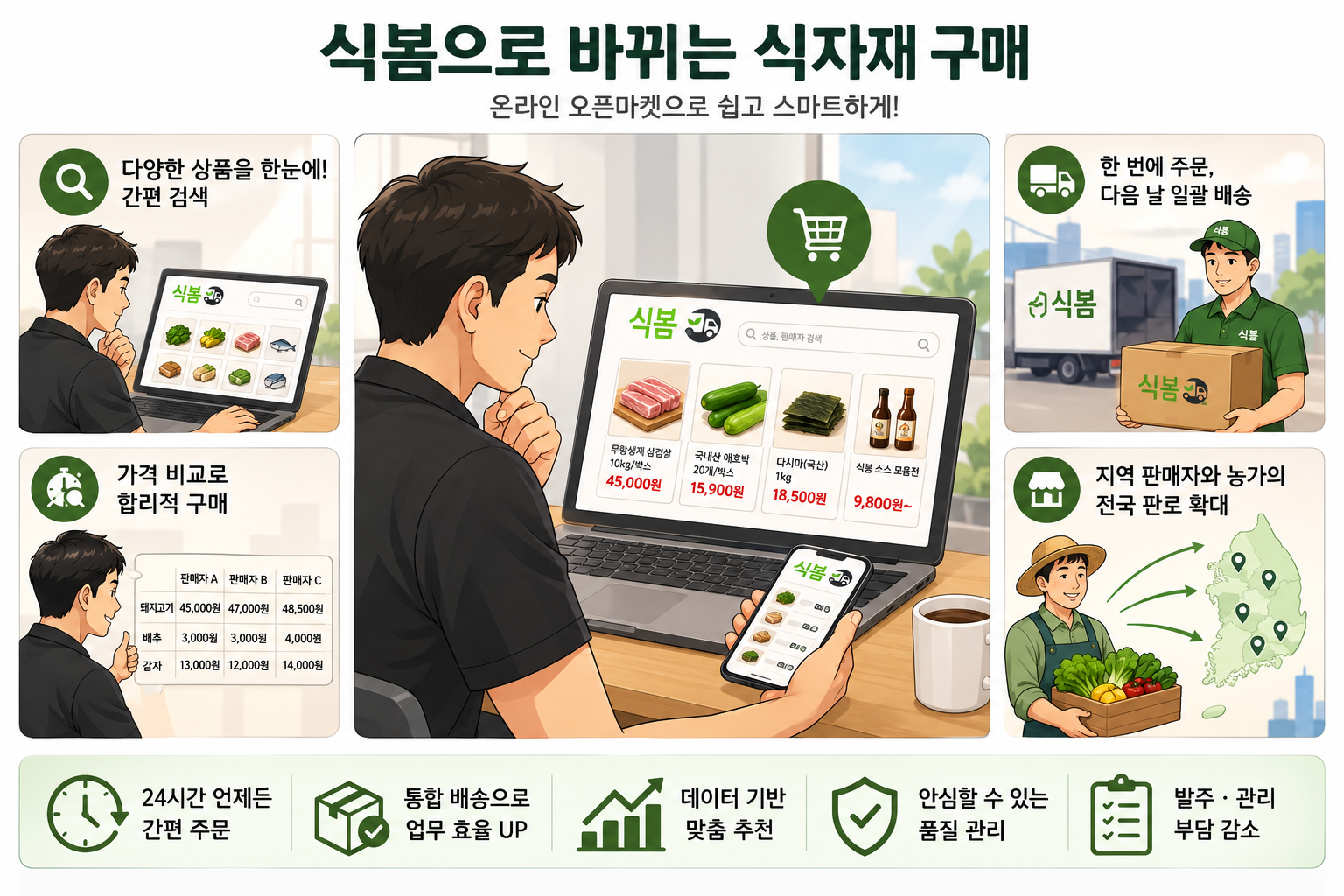
식자재 가격만 외식업자의 비용은 아니다. 상품을 검색하고 가격을 확인하고 거래처마다 주문하고, 각각 다른 시간에 들어오는 배송을 확인하는 데에도 시간과 인력이 필요하다. 다품목 식자재를 사용하는 업종이라면 이러한 발주·입고 관리의 부담은 더욱 커진다. 식봄의 통합배송은 여러 판매자의 상품을 한 번에 주문하고 다음날 일괄 수령할 수 있도록 해 이러한 업무 부담을 줄이는 방식이다.
신선식품과 가공식품, 소모품 등 여러 종류의 상품을 구매하는 외식사업자 입장에서는 주문처와 배송 일정을 따로 관리하는 번거로움을 줄일 수 있다. 결국 온라인 식자재 유통의 경쟁력은 단순한 ‘가격 비교’에서 끝나는 것이 아니라 발주와 물류에 들어가는 시간과 비용까지 줄이는 데 있다.
거래 과정이 데이터로 축적된다는 점도 강점이다. 어떤 상품이 얼마나 팔리는지, 어떤 업종에서 어떤 식자재를 반복 구매하는지, 계절이나 시기에 따라 수요가 어떻게 달라지는지를 파악할 수 있다. 이러한 데이터가 축적되면 공급자는 시장의 수요 변화를 보다 빠르게 파악할 수 있고 구매자에게 필요한 상품을 추천하거나 적기에 공급하는 것도 가능해진다.
신선식품 중심의 식자재 유통에서는 수요예측이 정확해질수록 재고와 폐기를 줄이는 데에도 도움이 될 수 있다. 상품을 많이 확보하는 것만큼 필요한 상품을 필요한 곳에 필요한 만큼 연결하는 능력이 중요해지는 것이다.
<생성형AI로 제작한 이미지>
■ CJ프레시웨이, 국내 식자재 유통 시장의 온라인 전환 선도
국내 최대 규모의 식자재 유통 기업인 CJ프레시웨이는 이러한 시장 변화에 대응해 식자재 유통의 온라인 전환에 속도를 내고 있다. 2026년 3월 CJ프레시웨이는 식자재 오픈마켓 리딩 플랫폼인 ‘식봄’의 운영사 마켓보로 지분을 추가 확보해 최대주주로 올라섰다. 마켓보로가 플랫폼 운영을 맡고, CJ프레시웨이는 전국 단위 콜드체인 물류망을 기반으로 배송 경쟁력을 지원하는 방식이다.
CJ프레시웨이와 마켓보로의 결합은 온라인 플랫폼과 오프라인 물류를 연결하는 데 의미가 있다. 식봄에는 2026년 6월말 기준 약 24만개의 식자재가 입점해 있고, CJ프레시웨이는 전국 23개 물류 거점과 콜드체인을 운영하고 있다. 온라인에서 다양한 상품과 판매자를 연결하는 플랫폼에 전국 단위 물류 인프라를 결합하면서 온라인 식자재 거래의 실제 배송 경쟁력을 높이는 구조다.
CJ프레시웨이가 식봄의 성장을 통해 기대하는 것도 단순한 온라인 매출 확대만은 아니다. 플랫폼을 통해 구매자와 판매자를 확대하고, 통합배송을 통해 물류 효율을 높이는 동시에 지역 기반 판매자에게 새로운 판로를 제공하는 등 식자재 유통 생태계 자체의 효율을 높이는 것이 목표다.

이처럼, CJ프레시웨이가 주도하는 식자재 유통의 온라인 전환은 단순히 전화 주문이 모바일 주문으로 바뀌는 변화가 아니다. 가격과 상품 정보를 보다 쉽게 비교할 수 있게 하고, 판매자와 구매자의 거래 비용을 낮추며, 지역에 있는 생산자와 판매자가 전국의 고객을 만날 수 있도록 한다. 여기에 통합배송과 데이터 기술이 더해지면 구매자의 발주 부담과 판매자의 물류 부담을 동시에 낮출 수 있다.
결국 핵심은 ‘연결’이다. 지역의 농가와 생산자는 더 넓은 판로를 확보하고, 판매자는 더 많은 고객을 만날 수 있으며, 외식·급식 사업자는 더 다양한 상품을 비교하고 효율적으로 구매할 수 있다. 온라인 플랫폼이 각각의 참여자를 연결하고, 물류 인프라가 이를 실제 거래로 완성하면 생산자에서 판매자, 구매자로 이어지는 새로운 유통 선순환이 만들어질 수 있다.
식자재 유통의 온라인(O2O) 전환이 주목받는 이유다. 가격과 거래의 효율을 높이는 것을 넘어 농가와 판매자, 외식·급식 사업자를 연결하고 각 참여자에게 새로운 기회를 제공하는 것. 식자재 유통의 온라인 전환은 결국 유통의 효율성을 높이는 동시에 산업 참여자의 성장을 돕고, 나아가 식품산업 전반의 선순환 구조를 만드는 새로운 방식으로 진화하고 있다.
※ B2B 식자재 유통 온라인 전환 효용성(표)
구분 |
내용 |
발주·거래 과정 효율화 | 전화나 대면으로 거래처별 주문을 진행하던 방식에서 벗어나 상품 검색부터 주문까지 온라인에서 처리할 수 있어 발주에 필요한 시간과 업무 부담 감소 |
상품·가격 비교 및 선택권 확대 |
여러 판매자의 상품과 가격, 배송 조건 등을 오픈마켓에서 한눈에 비교할 수 있어 구매자의 선택 폭이 넓어지고, 보다 합리적인 구매 의사결정 가능 |
통합배송 통한 물류 편의성 향상 및 전국 단위 판로 확대 |
여러 판매자의 상품을 한 번에 주문하고 일괄 배송받을 수 있어 배송 일정과 입고 관리 용이하며, 자체 영업망이나 전국 단위 배송망을 갖추기 어려운 지역 농가와 중소 판매자도 온라인 플랫폼과 물류 인프라를 활용해 전국의 외식·급식 사업자를 고객으로 확보 가능 |
데이터 기반 수요 대응 강화 |
상품별 판매량과 반복 구매, 업종별 구매 패턴, 계절별 수요 등의 거래 데이터가 축적돼 수요 변화를 파악하고 상품 추천과 공급 효율을 높이는 데 활용할 수 있으며, 이를 통한 신선식품의 재고와 폐기 감소 가능 |
From Legwork to Online Platforms:
Foodservice Distribution Enters a New Era
- Once reliant on phone calls and face-to-face transactions, foodservice distribution enters a new phase as platforms, data and logistics converge
- Beyond price comparison and transaction efficiency, online distribution opens new sales channels for regional sellers, paving the way for a virtuous distribution ecosystem
- CJ Freshway leads the digital
transformation of B2B foodservice distribution with its online marketplace,
Sikbom
The way restaurant operators purchase food ingredients is changing. In the past, it was common for restaurant owners to visit wholesale markets early in the morning to inspect products firsthand or call suppliers to place orders. Different categories — from agricultural, livestock and seafood products to processed foods — often came from different suppliers, requiring businesses to manage orders and deliveries separately. This is one reason why the foodservice distribution industry remained largely offline for so long.
In recent years, however, the industry has begun accelerating its shift
online. Restaurant operators can now compare a wide range of products and
prices and place orders through online platforms, while new services have
emerged that consolidate products from multiple sellers into a single delivery.
The transformation goes beyond simply changing how orders are placed. By connecting producers, sellers and buyers through a single platform, the industry is reducing inefficiencies in traditional distribution processes and creating new sales channels, reshaping the structure of foodservice distribution itself.
■ From Legwork to Systems: The Evolution of Foodservice Distribution
Foodservice distribution has become increasingly specialized alongside the
growth of the restaurant and institutional foodservice industries. In its early
days, transactions were centered around regional wholesale markets and small
and midsized distributors. As franchise restaurants, corporate foodservice
businesses and institutional catering expanded, however, demand grew for more
stable supply chains.
As a result, capabilities such as bulk purchasing, product sourcing,
logistics centers, cold-chain systems covering refrigerated and frozen
products, and food safety management became core competencies for foodservice
distributors. Restaurants, meanwhile, gained access to a wide range of ingredients
through specialized distributors instead of having to visit multiple markets
and suppliers themselves.
With the spread of the internet and mobile technology, ordering gradually
began shifting away from phone calls and face-to-face transactions toward online
channels. Initially, however, digitalization largely amounted to adding online
ordering functions to existing supplier relationships. A more fundamental
transformation began with the emergence of open marketplaces, where buyers
could compare and purchase products from multiple sellers in one place. Food
ingredients were beginning to form a marketplace of their own online.
■ B2B Online Foodservice Market Enters Full-Fledged Growth Phase
The growth of online foodservice distribution is evident in transaction
volumes. Sikbom, one of Korea’s leading B2B foodservice marketplaces, saw its
annual gross merchandise value (GMV) increase from approximately KRW 20 billion
in 2022 to KRW 56 billion in 2023, KRW 153.7 billion in 2024 and KRW 234.2
billion in 2025. Its 2025 GMV was roughly ten times the 2022 level.
Growth has continued in 2026. According to CJ Freshway’s second-quarter 2026 IR materials, Sikbom recorded cumulative GMV of KRW 151.3 billion in the first half of 2026, up 25.8% year on year.
The industry also sees the online food purchasing market as entering a full-fledged growth phase. In a CJ Freshway company report released on August 7, 2026, IBK Investment & Securities noted Sikbom’s GMV growth in the first quarter of 2026, along with increases in registered users and repeat purchases, as evidence that online food purchasing is gaining traction. The brokerage projected that Sikbom’s GMV could reach approximately KRW 280 billion in 2026 if the current growth trajectory continues. This suggests that the digital transformation of foodservice distribution is no longer experimental but is translating into tangible market growth.
■ Easier Price Comparison and More Streamlined Transactions
The significance of online foodservice distribution extends beyond buyer
convenience. One of the most immediate changes is greater ease in comparing
products and prices. Traditionally, restaurant operators had to contact
multiple suppliers individually to inquire about prices and terms. On an open
marketplace, by contrast, buyers can compare products, prices and delivery
conditions from multiple sellers in one place. Greater buyer choice and
increased competition among sellers can also contribute to greater transparency
and efficiency in transactions.
Another feature of online distribution is its potential to reduce
unnecessary steps in the distribution process and connect producers and sellers
more directly with buyers. Because food ingredient costs are directly tied to
the operating costs of restaurants and institutional foodservice businesses,
greater distribution efficiency could, over the long term, help ease purchasing
costs for foodservice operators and have a positive impact on food price
stability.
That does not mean, however, that shifting online automatically lowers the
prices of all food ingredients. Prices are affected by numerous factors,
including farm-gate prices, production costs and logistics expenses. The role
of online platforms is therefore less about determining prices themselves and
more about creating an environment where product and price information can be
compared transparently while reducing inefficiencies in the transaction
process.
On March 31, 2026, The Dong-A Ilbo reported that Korea’s B2B foodservice
distribution market, estimated at KRW 63 trillion, remains predominantly
offline, a structure that has undermined distribution efficiency and price
transparency. The report noted that major companies are promoting price
competition through online marketplaces, helping improve price transparency
while reducing costs by shortening distribution channels. Citing data from the
Ministry of Agriculture, Food and Rural Affairs, it also reported that the
distribution cost ratio for agricultural products could decline by
approximately 11 percentage points when distribution shifts online.
■ Regional Sellers Gain Access to Customers Nationwide
Another benefit of online foodservice distribution is expanded market
access. Even producers and distributors with high-quality regional products
need sales networks and logistics infrastructure to sell nationwide. For small
and midsized food manufacturers and distributors, as well as regional sellers,
building a nationwide delivery network independently can be particularly
challenging.
Combining online platforms with logistics infrastructure can lower these
barriers. Sellers can use platforms to reach restaurant operators nationwide,
overcoming geographic limitations, while buyers gain online access to a broader
range of regional food products that may previously have been difficult to
source.
The benefits become even greater when products from multiple sellers can
be consolidated within a single logistics network. Sikbom operates a
consolidated delivery service that utilizes CJ Freshway’s nationwide network of
23 logistics hubs and cold-chain infrastructure. Products from multiple sellers
are consolidated and delivered together the following day. According to CJ
Freshway’s second-quarter 2026 IR materials, the number of consolidated
deliveries through Sikbom reached approximately 13,000 as of the end of June
2026, up 117.2% year on year.
Sellers without their own delivery networks can use this logistics
infrastructure to supply products to restaurant operators nationwide. Starting
in June 2026, CJ Freshway began bringing approximately 20 new sellers onto
Sikbom in phases. In this way, online platforms are evolving beyond simple
“sales spaces” to become infrastructure that reduces sellers’ logistics burdens
while expanding their market reach.
The impact is already evident among regional sellers that have joined
Sikbom. Chef’s Garden, a vegetable farm based in Icheon, Gyeonggi Province, saw
its monthly sales increase approximately 15-fold within six months of joining
the platform. The growth came as its sales network expanded from a regional to
a nationwide customer base.
“Previously, when we shipped vegetables by parcel delivery, they were
not transported through a cold-chain system, making it difficult to guarantee
quality and limiting our ability to sell to customers farther away,” said Lee
Geun-ho, CEO of Chef’s Garden. “Since joining Sikbom, we have been able to use
CJ Freshway’s cold-chain logistics network to deliver anywhere in Korea. With
the platform supporting distribution and sales, we now have a structure that
allows us to focus on production.”
The case demonstrates how combining farms, online platforms and logistics
networks can expand market opportunities for agricultural producers.
■ Data Helps Restaurant Operators Reduce ‘Hidden Costs’
The price of ingredients is not the only cost restaurant operators face.
Searching for products, checking prices, placing separate orders with multiple
suppliers and receiving deliveries arriving at different times all require time
and labor. For businesses purchasing a large number of different ingredients,
the burden of managing orders and incoming deliveries can be even greater.
Sikbom’s consolidated delivery service is designed to reduce that workload
by allowing buyers to order products from multiple sellers and receive them
together the following day.
For restaurant operators purchasing a mix of fresh foods, processed
products and supplies, this reduces the need to manage multiple ordering
channels and delivery schedules separately. Ultimately, the competitiveness of
online foodservice distribution goes beyond price comparison. It also lies in
reducing the time and costs associated with ordering and logistics.
Another advantage is that transactions generate data. Platforms can track
which products are selling, which ingredients are repeatedly purchased by
different types of businesses, and how demand changes by season or time period.
As this data accumulates, suppliers can identify shifts in market demand more
quickly, recommend relevant products to buyers and supply them at the right
time.
In foodservice distribution, where fresh products play a major role, more
accurate demand forecasting can also help reduce excess inventory and food
waste. The ability to connect the right products with the right customers in
the right quantities is becoming just as important as securing sufficient
product supply.
■ CJ Freshway Leads the Digital Transformation of B2B Foodservice Distribution
CJ Freshway, Korea’s largest foodservice distribution company, is
accelerating the industry’s online transformation in response to these market
changes. In March 2026, the company acquired an additional stake in Marketboro,
operator of the leading foodservice marketplace Sikbom, becoming its largest
shareholder. Under the partnership, Marketboro operates the platform while CJ
Freshway supports its delivery capabilities through its nationwide cold-chain
logistics network.
The combination of CJ Freshway and Marketboro is significant because it
connects an online platform with offline logistics infrastructure. As of the
end of June 2026, Sikbom offered approximately 240,000 foodservice products,
while CJ Freshway operated 23 logistics hubs and a nationwide cold-chain
network. By combining a platform that connects a wide range of products and
sellers online with nationwide logistics infrastructure, the partnership
strengthens the physical delivery capabilities underpinning online foodservice
transactions.
CJ Freshway’s ambitions for Sikbom extend beyond simply increasing online
sales. The company aims to expand the platform’s buyer and seller base, improve
logistics efficiency through consolidated delivery and create new sales
channels for regional sellers — ultimately enhancing the efficiency
of the broader foodservice distribution ecosystem.
The digital transformation of foodservice distribution led by CJ Freshway
is therefore about far more than replacing phone orders with mobile orders. It
makes product and price information easier to compare, reduces transaction
costs for sellers and buyers, and enables regional producers and sellers to
reach customers nationwide. Combined with consolidated delivery and data
capabilities, it can reduce both the ordering burden for buyers and the
logistics burden for sellers.
At its core, the transformation is about connection. Regional farms and
producers gain access to broader markets, sellers can reach more customers, and
restaurant and institutional foodservice operators can compare a wider variety
of products and purchase them more efficiently. When an online platform
connects these participants and logistics infrastructure turns those
connections into actual transactions, a new virtuous cycle can emerge across
the distribution ecosystem — from producers to sellers to buyers.
This is why the online, or O2O, transformation of foodservice distribution
is attracting attention. Beyond improving pricing transparency and transaction
efficiency, it connects farms, sellers, restaurants and institutional
foodservice operators while creating new opportunities for each participant.
Ultimately, the online transformation of foodservice distribution is evolving
into a new model that not only improves distribution efficiency but also
supports the growth of industry participants and helps create a virtuous cycle
across the broader food industry.
※ Benefits of the Digital Transformation of B2B Foodservice Distribution
Category | Details |
Streamlined Ordering and Transactions | Moving away from phone- and face-to-face ordering allows buyers to handle the entire process online, from product searches to order placement, reducing the time and workload required for procurement. |
Easier Product and Price Comparison and Greater Choice | Buyers can compare products, prices and delivery terms from multiple sellers at a glance on an open marketplace, expanding their options and enabling more informed purchasing decisions. |
Efficient Logistics & Nationwide Reach | Buyers can order products from multiple sellers and receive them in a single consolidated delivery, simplifying delivery scheduling and inventory receiving. Regional farms and small and midsized sellers without their own nationwide sales or delivery networks can also leverage online platforms and logistics infrastructure to reach restaurant and institutional foodservice customers across the country. |
Enhanced Data-Driven Demand Management
| Transaction data, including product sales, repeat purchases, purchasing patterns by business type and seasonal demand, can be used to identify shifts in demand and improve product recommendations and supply efficiency. More accurate demand forecasting can also help reduce excess inventory and waste, particularly for fresh food products. |
최종 업데이트일 : 2026년 8월 21일
 타깃플랫폼
타깃플랫폼
 고객상담센터